
Most product leaders treat launch planning as a downstream activity, something that kicks in after development wraps up. But what if your launch strategy could actually shape the product itself, integrating customer insights, manufacturing realities, and market positioning from day one?
At Nottingham Spirk, we have discovered that the most successful product launches eliminate the traditional departmental handoffs between development, go-to-market planning, and commercialization. This is why our Vertical Innovation® product development process integrates all disciplines from the start, achieving a 95% commercialization rate compared to the industry average of five percent.*
Why Most Product Launch Strategies Fall Short
The fundamental challenge isn’t a lack of process documentation. The challenge is organizational.
When product development, marketing, and commercialization operate in isolated silos, critical insights get lost in the handoff. Engineers make technical decisions without understanding market positioning. Marketing teams develop messaging without grasping manufacturing constraints. Commercialization experts inherit products they had no role in shaping.
But here’s what most companies miss: your product development timeline isn’t just a countdown to launch day; it’s a direct predictor of your market success. A well-integrated launch strategy treats the timeline not merely as a schedule, but as the ultimate coordination tool.
Step 1: Establish Your Launch Readiness Framework
Start by defining what “ready to launch” actually means for your organization. This requires real-time input from every functional area simultaneously.
Engineers understand technical milestones and testing requirements. Market researchers understand customer validation criteria. Supply chain experts know production ramp timelines. When these perspectives converge around your launch framework, gaps that typically surface late become visible early.
Ask yourself: What does your development team consider a finished product? What does your commercialization team need to start sales enablement? What does your marketing team require to build positioning? The answers will rarely align without deliberate coordination.
Step 2: Build Your Multidisciplinary Launch Team
The most successful new product introductions emerge from teams that combine diverse expertise from the project’s inception, not just at launch time.
This is the core of Vertical Innovation®. Nottingham Spirk houses design, engineering, market research, and commercialization under one roof to form a truly integrated team. We empower specialists across every discipline with the real authority to shape your product launch.
Give your team the authority to challenge existing industry assumptions. The development of the P&G SpinBrush™ exemplifies this approach. When the industry assumed that an electric toothbrush couldn’t be sold for under $5, our integrated team looked outside the dental category entirely. By leveraging our deep expertise in toy manufacturing, we adapted rotating battery-powered mechanisms to achieve a $1.25 manufacturing cost. It disrupted a category, led to a massive acquisition by Procter & Gamble, and created a new market standard.
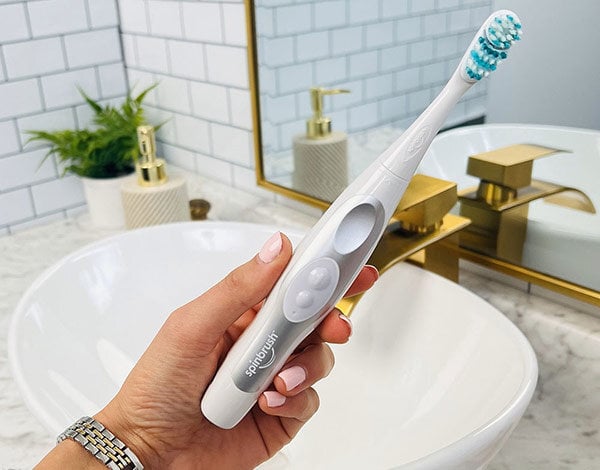
SpinBrush™: The first electric toothbrush under $5
Step 3: Align Your Product Development Timeline with Go-to-Market Planning
Traditional product development timelines focus on technical milestones: prototype completion, testing phases, and regulatory approvals. A launch-integrated timeline adds market readiness milestones running in parallel.
Consider mapping your go-to-market planning activities against your development phases:
- During concept validation: Define target customer segments and initial positioning hypotheses
- During prototype development: Conduct customer research and refine value proposition
- During design refinement: Develop sales enablement materials and channel strategy
- During production preparation: Execute pre-launch marketing and demand generation
This parallel approach accelerates time to market. Research shows that companies using integrated development and commercialization processes can achieve launch timelines of nine to twelve months versus the industry standard of eighteen to twenty-four months.
Step 4: Create Feedback Loops Between Development and Market Insights
The key is understanding the gap between what your product currently delivers and what your customers actually need. Only through rigorous customer research can you identify these hidden opportunities before launch.
Build mechanisms for market insights to influence product decisions throughout development:
- Regular customer validation sessions: Schedule prototype reviews with target customers at key phases in development
- Competitive intelligence briefings: Keep development teams informed about market movements and competitor launches
- Manufacturing cost updates: Share evolving cost structures so marketing can refine positioning and pricing strategies
This insight only emerges through consistent communication between disciplines. When our teams examine market dynamics alongside technical progress, patterns emerge that reshape product strategy.
Step 5: Define Clear Commercialization Milestones
Commercialization readiness involves more than having product available for shipment. It requires sales team training, channel partner alignment, customer support preparation, and demand generation infrastructure.
Set clear objectives for each commercialization element:
- Sales enablement: When will your sales team have the training, materials, and tools to effectively sell the product?
- Channel readiness: When will distribution partners have inventory, training, and promotional support?
- Support infrastructure: When will customer service teams be prepared to handle inquiries and issues?
- Marketing activation: When will demand generation campaigns be fully deployed?
The Twist & Pour paint container developed for Sherwin-Williams demonstrates this approach. Nottingham Spirk’s team didn’t just design a better container; they planned the commercialization pathway, including retail presentation, customer education, and retail outlet expansion, from the project’s earliest phases. This strategy revived the Dutch Boy brand, tripling sales in the first six months after launch.

Step 6: Implement Launch Readiness Reviews
Establish formal checkpoints where all functional areas assess readiness against predefined criteria. These reviews should occur at consistent intervals throughout the development process.
An effective launch readiness review includes:
- Technical readiness: Is the product meeting performance specifications?
- Manufacturing readiness: Can production meet anticipated demand at target costs?
- Market readiness: Is positioning validated? Are marketing assets prepared?
- Commercial readiness: Are sales teams trained? Are channel partners aligned?
What user frustrations could you eliminate by identifying them earlier? What competitive advantages could you build by launching with fully prepared commercialization infrastructure?
Step 7: Plan for Post-Launch Iteration
Product launch is just the beginning of a product’s growth arc. The best product strategies build in the mechanisms needed to listen, learn, and rapidly capitalize on market adoption.
Your launch strategy should focus on:
- Customer insight collection: Systems for capturing and analyzing authentic user experiences
- Rapid response capability: Streamlined workflows that allow your team to iterate swiftly and capture new value
- Strategic roadmap progression: Strategic framework for prioritizing and implementing future releases, expansions, and line extensions
The process demands both technical expertise and creative thinking. Products that felt mature reveal new possibilities when examined through real-world customer feedback.
Making It Happen
Start by assembling an empowered, multidisciplinary team to challenge your existing launch assumptions. Give them a clear mandate to integrate product development, go-to-market strategy, and commercialization from day one. To succeed, set unified objectives across all functional areas and be prepared to reexamine how your organization brings products to market.
Ask yourself:
- Can you consolidate development and launch planning into a single, seamless process?
- Are you investing adequately in commercialization prep while development is still underway?
- What market opportunities could you capture with a faster, more coordinated launch?
Your product launch strategy is far more than a timeline of milestones; it is the blueprint for your market success. The question is whether launch planning remains an afterthought, or becomes the key to unlocking the high-value advantages hiding in plain sight.
*Jay Walker, “The Real Patent Crisis Is Stifling Innovation,” Forbes, June 18, 2014
About Nottingham Spirk
Nottingham Spirk is a world-class product innovation firm with an unrivaled record of developing and commercializing disruptive consumer products, medical devices, digital IoT products, and connected industrial products. We collaborate with Fortune 1,000, middle market, and funded venture companies to discover, design, and execute product innovation programs and strategic business platforms that will delight customers, grow markets, and generate new revenue streams. Learn more about our approach to new product development.
Submit a comment